

 Published
 8 min read
In this article
Key takeaways
- Build a story around one real routine and the information a child needs.
- Review the words, pictures, and page sequence with the people who know the child.
- Explore Occibo's planned path from an editable story to a printed book for school or home.
A new classroom. A first library visit. A different teacher on Tuesday. Sometimes the most useful children’s book is the one that explains a small, unfamiliar part of a child’s day.
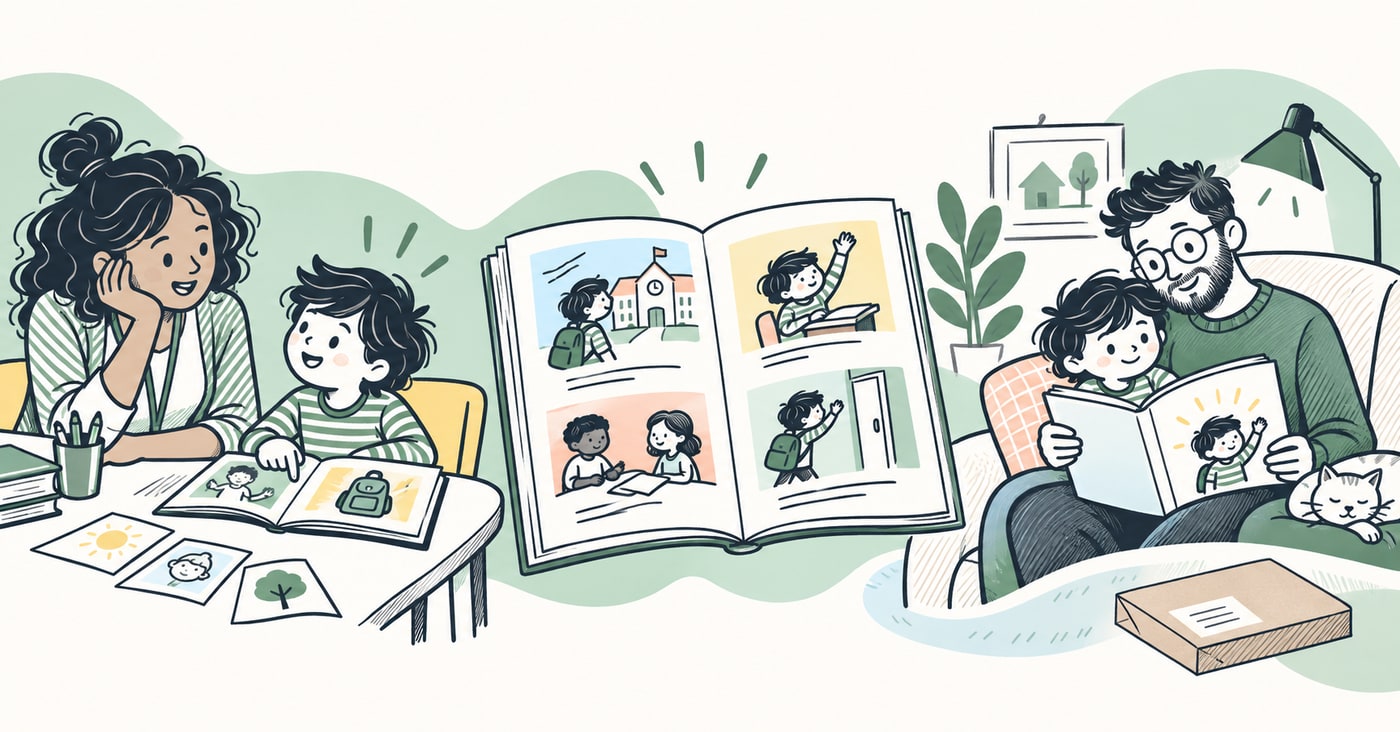
A personalized social story book brings that situation into a short sequence of words and pictures. A teacher can help shape the classroom details; a parent or caregiver can read the same story at home. The aim is to share understandable information and invite questions, with the child’s perspective at the centre.
Occibo is being developed to connect that process: plan the story, explore illustrations, review the pages, and prepare a finished book. The planned direction includes printed books delivered to school or home. Occibo is currently at the early-access waitlist stage; printing, ordering, and delivery are planned, with availability and details still to be confirmed.
What makes a social story useful for a child?
A useful starting point is one real situation and one question: what information is missing for this child?
For a first library visit, that might be who will walk with the class, where the books are, how borrowing works, or whom to ask for help. For a classroom change, it might be what stays familiar and what will be different.
The story should describe the situation accurately, leave room for different feelings, and explain support that is actually available. It should not promise that an unfamiliar experience will feel easy or demand a particular emotional response.
There is also a distinction in terminology. Carol Gray’s formal Social Stories approach has defined criteria. A story created with an AI social story generator is not automatically a formal Social Story. If you use that methodology, follow the current Social Stories criteria and review the material with an appropriately knowledgeable educator. Occibo’s planned workflow does not replace that judgement.
Start with a classroom moment, not a blank page
Before opening a social story maker, write a brief that a colleague could understand:
- Reader: one child, a small group, or the whole class.
- Situation: one routine or upcoming event, such as visiting the school library.
- Known sequence: what will happen, where, and with whom.
- Useful support: the person or option the child can turn to.
- Language and pictures: vocabulary and visual details the reader recognises.
For kindergarten and primary school teachers, possible topics include arriving at school, meeting a new teacher, finding the lunch area, or preparing for a class trip. Choose the details that answer the child’s questions rather than trying to cover every school routine in one book.
For a broader introduction, read our guide to creating personalized social stories for individual students or a whole class. Here, the focus is the next step: making a coherent picture book that can travel between school and home.
How Occibo’s planned social story book workflow fits together
The intended workflow combines writing, visual planning, and book preparation. These are the stages teachers and families would work through, with adult review throughout.
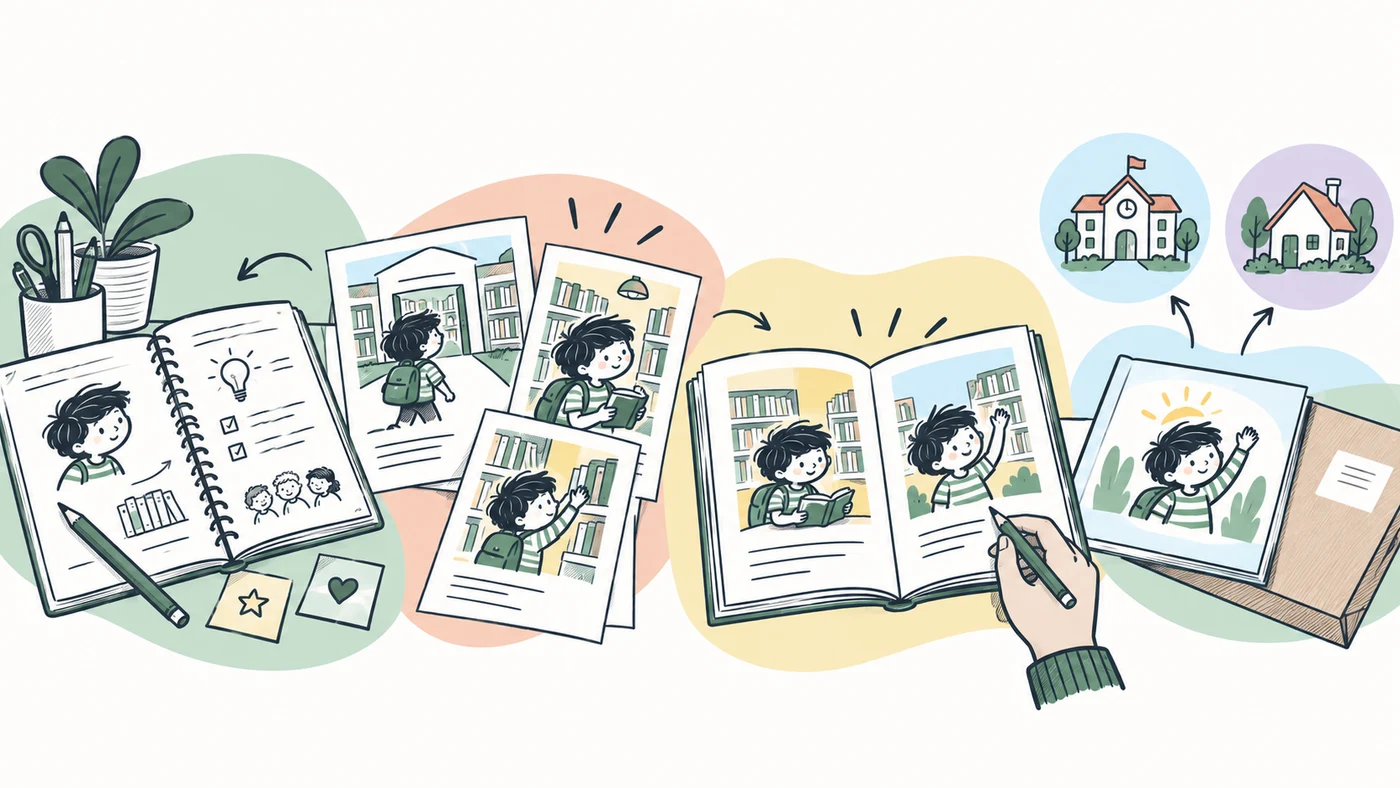
1. Describe the child or class and the real situation
Begin with the brief. Use only the personal details needed to make the story understandable. A fictional name can be enough while exploring a first draft; a diagnosis or detailed personal history is not automatically necessary.
Invite the child’s input where possible. Their question may be different from the one an adult first expected.
2. Shape an editable story draft
Occibo’s planned AI-assisted writing tools would help turn the brief into a page-by-page draft. The adult’s role is to check facts, simplify confusing language, and replace assumptions with information they know.
For example, “My teacher can show me where to put my bag” is only useful if that support is available. If the routine varies, the story should say so clearly.
3. Create social stories with pictures that explain the words
Illustrations should help the reader recognise the people, place, or action on a page. Keep the main character and important visual details consistent. A recognisable classroom entrance may be more useful than a decorative scene full of unrelated objects.
Occibo’s planned character and scene exploration would support that visual preparation. Check every image: an attractive illustration can still show the wrong room, missing equipment, or an inaccurate action.
4. Review the book together
Read the draft aloud and inspect the page sequence. Check that each spread has a clear purpose, the type is readable, and the pictures leave space for the words.
A teacher can confirm the school routine. A parent or caregiver can flag unfamiliar vocabulary. Where appropriate, let the child point out what is unclear or missing. A review may lead to a shorter story, a different picture, or a practical change outside the book.
5. Prepare a printed book for school or home
After the content and layout are approved, the intended next step is print preparation and a physical book. Occibo’s planned delivery direction includes school and home destinations, so the story can become something a child returns to with familiar adults.
Book formats, print prices, supported destinations, and delivery times will be shared as the service develops.
A short example: Leo visits the school library
The following is an original, fictional planning example, not a formally assessed Social Story. Assume Leo’s teacher has confirmed this particular library routine. In a real book, replace every detail that does not match the child’s school.
Page 1: A place for books
“Our school has a library. There are books to look at and borrow.”
Picture direction: a simple view of the library entrance and a few recognisable shelves.
Page 2: Going with my class
“On Tuesday, my class plans to visit the library with our teacher.”
Picture direction: the teacher and a small group arriving together. Keep Leo’s appearance consistent across pages.
Page 3: Finding something to read
“My teacher can show me where to look. I can choose a book to explore.”
Picture direction: books within reach, with the teacher nearby.
Page 4: When I have a question
“Some things in the library may be new to me. I can ask my teacher a question or show them what I need help with.”
Picture direction: space for a simple interaction, without prescribing a facial expression or feeling.
Page 5: Taking a book home
“My teacher will help me borrow a book. I can look at it again at home.”
Picture direction: the borrowed book with Leo and a caregiver at home.
This example has a small scope. It does not need a dramatic plot or a lesson about being a “good” pupil. Its job is to explain a sequence that the adults can confirm.
One child or a whole class: what should change?
A personalized book for one child can use the specific information they need. A shared classroom book should describe common routines without exposing an individual pupil’s private circumstances.
For a class edition, a fictional guide character may work better than a named student. For a family edition, a caregiver can help identify which details matter during reading at home. Do not assume that one child’s version is appropriate for every pupil.
The wider Occibo classroom-book workflow for teachers covers other book ideas for kindergarten and primary schools. Families can also explore creating storybooks with their children.
From a printable social story to a book children can revisit
A printable social story can be useful when a routine changes quickly. A finished book may suit a story that a child will revisit across several weeks or share between familiar settings. Choose the format around the reader and the situation.
Before preparing a printed social story book, check:
- Accuracy: the names, places, sequence, and available support are correct.
- Readability: the actual page size leaves comfortable room for text and pictures.
- Privacy: any personal information or images are appropriate for the intended readers.
- Handoff: the teacher and caregiver know which version they are using.
- Revisions: someone will check the story again if the routine changes.
A book delivered to school might be read before the activity. A home copy could give a caregiver a starting point for conversation. Neither needs to become a test: make space for questions, disagreement, and new information from the child.
Questions about social story books for school and home
Can I use Occibo as a social story maker for teachers?
That is one of the planned use cases. Occibo is being designed for educators as well as children’s book authors, illustrators, and families. The social story workflow would connect a real classroom situation with writing, illustration exploration, layout review, and book preparation. Access is currently through the waitlist.
Can I create a social story with pictures or my own photos?
The planned workflow includes illustration exploration. If familiar photos would explain a place more accurately, note that in your brief and use images you have permission to share. Details of photo-upload support will be shared as features become available.
Will the printed book be delivered to my school or home?
School and home delivery are part of the planned direction. Ordering availability, destination coverage, formats, costs, and delivery schedules still need confirmation before anyone places an order.
Is Occibo a free social story generator?
You can join Occibo’s early-access waitlist now. The creation tools are not yet publicly available. Access offers and credit terms will be shared with invitations, with print and delivery pricing confirmed separately.
Can the story be adapted for an autistic child?
Start with the individual child’s questions, communication preferences, and real environment. Involve the people who understand their needs and follow the formal criteria if you are creating a Social Story. An AI-generated draft is not a diagnosis, therapy, or a guarantee of a particular outcome.
A small story, shared between school and home
The useful starting point is simple: one child or class, one real situation, and a book that answers relevant questions.
Occibo’s planned contribution is to bring the creative and production steps together, from the first draft to a reviewed picture book and, when available, printing and delivery. Teachers and families remain the people who make the story accurate and personal.
Join the Occibo waitlist for first access and updates on the social story book workflow.
Sources and further reading
References and background reading for this article.
- Social Stories 10.4: Current Criteria Carol Gray Social Stories · Supports: the distinction between a personalized social narrative and the formal Social Stories methodology
Build your children’s book workflow with more clarity.
Join Occibo to plan stories, shape visual prototypes, and prepare better publishing steps.

Related articles
View all articles
Educators · Social stories ·