Published
 11 min read
In this article
Key takeaways
- Late scene changes, unclear briefs and layout surprises can add avoidable work to a children's book budget.
- A book dummy helps authors review pacing, characters and text placement before commissioning final illustration.
- Prototyping supports author-illustrator collaboration; potential savings depend on the project and working agreement.
When authors research the cost to self-publish a children’s book, they usually start with the visible expenses: illustration, editing, ISBNs, printing and any fees associated with their chosen publishing route.
Yet costly surprises often arise between a finished manuscript and a finished book.
A scene changes after an illustration has already been completed. A character description was unclear. The author imagined a page differently from the illustrator. A spread becomes too crowded once the text is placed. The trim size changes late. An illustration needs another revision.
Individually, these may seem small. Across a 24- or 32-page picture book, they can add significant time, cost and communication.
The problem is not necessarily the illustrator or the author.
Often, the underlying problem is that important decisions are left until final production. Planning them earlier can make the entire children’s book self-publishing process clearer.
Children’s book illustration is usually the largest production cost
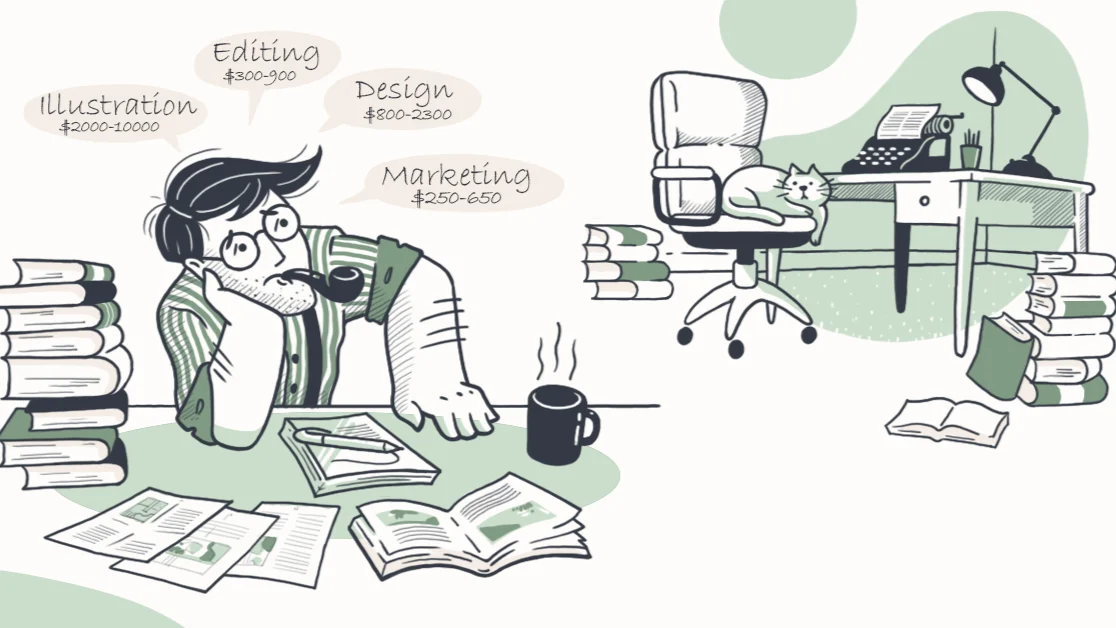
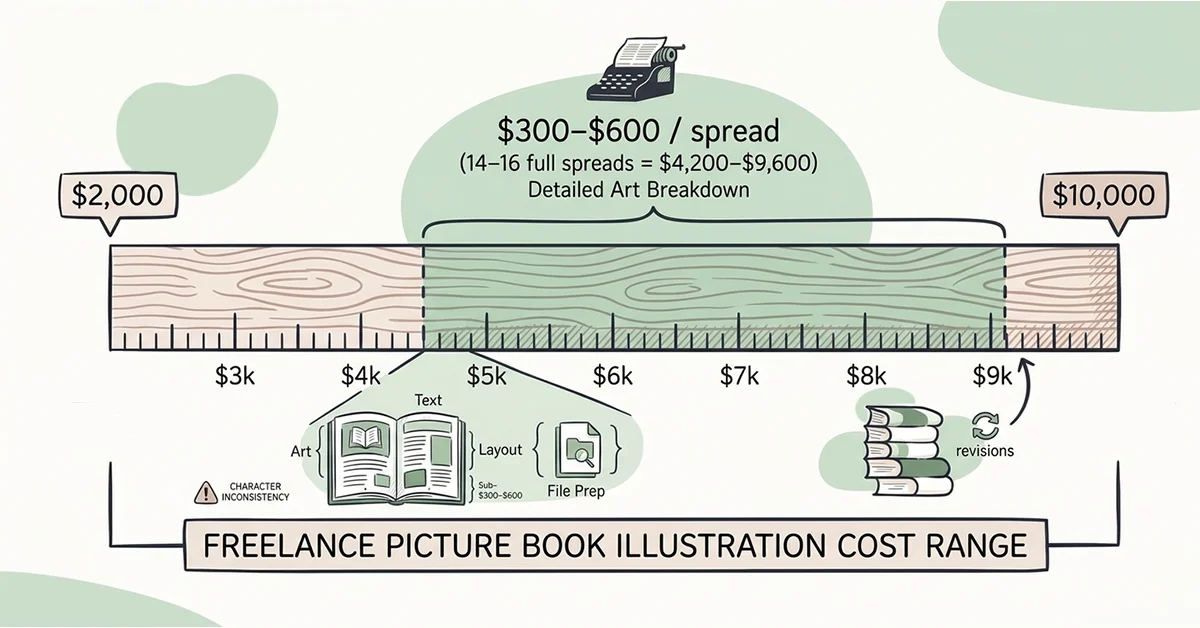
For most professionally produced picture books, illustration is one of the largest parts of the budget. In the original article’s illustrative budget, artwork accounts for $2,000–$10,000. A separate spread-based example uses $300–$600 per spread, or $4,200–$9,600 for 14–16 illustrated spreads.
The children’s book illustration cost varies considerably depending on the illustrator’s experience, style, licensing terms, complexity, number of illustrations and revision agreement.
And that investment makes sense.
A professional children’s book illustrator does much more than create attractive pictures. An illustrator interprets the manuscript, develops visual storytelling, creates emotion and personality, controls composition and brings a distinctive artistic voice to the book.
The real opportunity for reducing production cost is therefore not simply:
How can I make illustration cheaper?
A better question is:
How can I make better decisions before expensive final illustration begins?
The hidden cost is often rework
Imagine an author commissions an illustrator for a 32-page picture book.
The illustrator begins developing finished artwork. A few spreads later, the author realizes:
-
An important scene should happen earlier.
-
The protagonist’s clothing needs to change.
-
Two scenes feel visually repetitive.
-
There is not enough room for text.
-
A double-page spread would work better than two separate illustrations.
-
A secondary character needs to appear earlier.
-
The ending needs another page.
-
The author simply imagined the scene differently.
These are normal creative discoveries.
The problem is when they happen.
A change to a rough storyboard may take only minutes.
Changing a finished professional illustration may require another revision round.
Multiply this across several scenes and the project can quickly accumulate additional emails, calls, sketches, revisions and weeks of work.
Why author–illustrator communication can become difficult
A manuscript communicates the story through words.
An illustrator needs to translate those words into a visual system.
That leaves many decisions that may not exist explicitly in the manuscript:
-
What does the protagonist look like?
-
Which moments deserve full-page illustrations?
-
What should happen across a double-page spread?
-
Which characters appear in each scene?
-
Where is the scene taking place?
-
What is each character wearing?
-
How much room should remain for text?
-
Which visual details need to remain consistent later?
-
What should the reader see before turning the page?
Authors frequently carry some of these answers in their heads.
The illustrator cannot see that mental picture.
So the gap gets resolved through briefs, reference images, sketches, emails, meetings and revision rounds.
Good collaboration always needs communication. A clear children’s book illustrator brief, supported by visual references, helps make those conversations more productive.
Prototype the children’s book before creating final illustrations
Product designers rarely manufacture a finished product before creating prototypes.
Architects do not start construction before plans exist.
A children’s book can benefit from the same principle.
Before commissioning final artwork, an author can create a picture book dummy: a rough, page-by-page version of the entire book. This book blueprint and visual prototype makes the story’s structure visible before finished illustrations begin.
It does not need finished artwork.
Its purpose is to answer questions.
For example:
-
How should the manuscript divide into scenes?
-
What happens on each page or spread?
-
Where are the strongest page turns?
-
Which characters appear in each scene?
-
What should the major locations look like?
-
Which scenes need full-page, half-page or spot illustrations?
-
Where could the text sit?
-
Does the visual rhythm become repetitive?
-
Does the story feel too long or too short?
-
Does the climax receive enough visual space?
Now the author can see the book as a book—not simply as a manuscript.
A visual prototype is not the final illustration
This distinction matters.
A prototype is there to communicate intent, not replace the illustrator’s craft.
Think of it as a visual conversation between the manuscript, the author and the illustrator.
The author might arrive with:
- Manuscript
- scene plan
- character direction
- visual references
- rough spreads
- book dummy
- illustrator brief
The professional illustrator then takes that direction and develops the final artwork in their own creative process and style.
The prototype answers:
“What are we trying to create?”
The illustrator answers:
“How should this become compelling final artwork?”
Those are different jobs.
Why this can improve the illustrator relationship
A detailed visual blueprint gives the illustrator more context at the beginning of the project.
Instead of writing:
“Maya is standing in the forest and looks worried.”
the author can communicate the broader scene:
Maya has just lost sight of her brother. It is late afternoon. This is the same forest established three spreads earlier. Maya is wearing the yellow raincoat introduced at the beginning of the story. The next page reveals the fox, so it should not yet be visible. Text needs quiet space in the upper-left area.
The illustrator still decides how to interpret this artistically.
But the production intent is much clearer.
That can reduce clarification cycles and help both sides identify disagreements before final artwork is produced.
The author can also change their mind earlier
This may be the biggest benefit of prototyping.
Authors need room to experiment.
Perhaps you thought a scene needed a dramatic double-page spread. After seeing the book dummy, you realize the emotional moment on the following page deserves that space instead.
Change it.
Perhaps your protagonist appears in 14 consecutive scenes and the visual rhythm feels repetitive.
Change it.
Perhaps the manuscript reads beautifully aloud but feels crowded when divided across pages. Reviewing children’s book structure and pacing alongside the dummy can help you spot the problem.
Change it.
At the prototype stage, these changes are relatively inexpensive.
After final illustration, layout and print preparation, the same decisions become much more costly.
The goal is therefore not to eliminate revision.
It is to move more revision earlier in the process, when revision is easier.
Layout decisions also affect illustration
Illustration and book layout should not be treated as completely separate decisions.
A beautiful illustration can still create problems if there is nowhere appropriate for the text.
Picture books need to consider:
-
Trim size.
-
Page dimensions.
-
Bleed.
-
Safe areas.
-
Gutter.
-
Text placement.
-
Page turns.
-
Spread composition.
-
Visual pacing.
If these decisions happen only after illustrations are complete, the designer may need to crop artwork, reposition text awkwardly or request changes.
A book blueprint makes these constraints visible earlier. If you plan to publish through Amazon, use the KDP children’s book formatting guide to inform those early layout decisions.
The illustrator can then receive not just a manuscript, but useful production context for each scene.
Where Occibo fits
This is the problem Occibo is being designed to address.
Occibo is being developed as an AI-assisted children’s book creation studio to help authors turn a manuscript into a clear book blueprint and visual prototype before final illustration.
The planned workflow takes an author through:
-
Manuscript
-
Story, scene and pacing plan
-
Character and location direction
-
Visual scene prototypes
-
Page and spread exploration
-
Book dummy
-
Review and changes
-
Illustrator-ready handoff
-
Final professional illustration
The author remains in control of the story.
The illustrator remains responsible for the final professional artwork.
Occibo works in the space between them: helping turn ideas that may exist only in the author’s head into something both sides can see and discuss.
Can this reduce the cost of illustrating a children’s book?
Potentially—but the mechanism matters.
The objective is not to reduce cost by removing the illustrator.
The potential saving comes from reducing avoidable production work around the illustrator:
fewer ambiguous briefs, fewer clarification cycles, fewer late structural changes, fewer layout surprises and potentially fewer revisions caused by misunderstandings.
For example, finding a problem with spread 12 while reviewing a rough book dummy is very different from finding it after spread 12 has been professionally illustrated.
Actual savings will vary by project, illustrator and working agreement. A complex book may still require substantial iteration.
But making decisions earlier gives both author and illustrator a clearer starting point.
Other children’s book production costs authors should plan for
Illustration is only one part of the cost of self-publishing a children’s book.
Depending on how you publish, your budget may also include:
Editing and proofreading
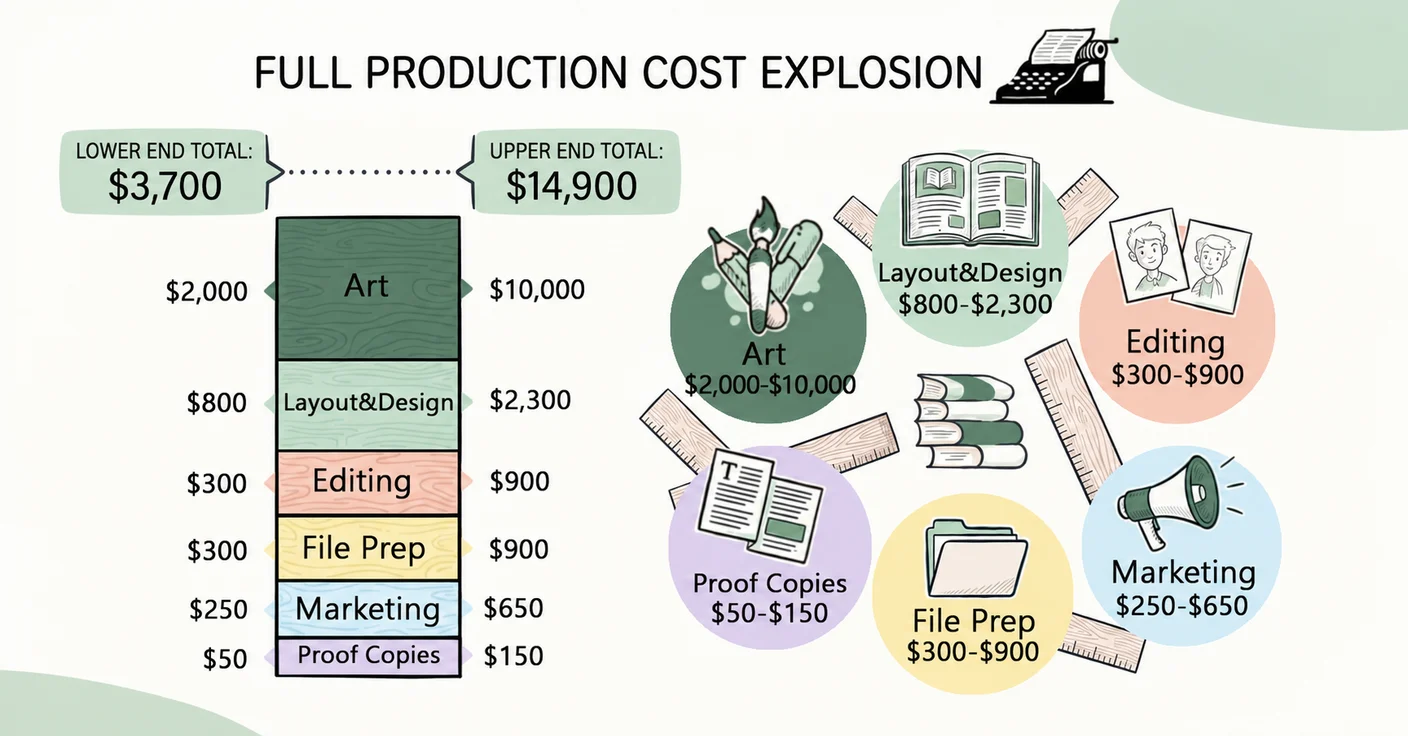
Developmental editing, copyediting and proofreading help ensure the manuscript works for its intended age group. The illustrative allowance here is $300–$900. The final amount depends on the manuscript’s length and condition, the level of editing required and whether proofreading is quoted separately.
Book design and layout
Illustrations and text still need to become a properly designed interior. An illustrative $800–$2,300 design and layout budget allows for work such as page composition, typography and preparing the cover and interior as a coherent book. Ask what the quote includes, because some designers price the cover separately.
Cover design
The front cover, back cover and spine need to work as a complete publishing asset. The example budget does not assign cover design a separate line item; it treats it as part of the broader design allowance. If your layout quote excludes the cover, budget for it separately rather than assuming it is included.
Print preparation
Trim size, bleed, margins, colour and export settings must meet the requirements of your printer or publishing platform. The illustrative budget reserves $300–$900 for print file preparation. This is production work on the files, not the cost of printing books.
Proof copies
The example sets aside $50–$150 for physical proofs to check colour, cropping, text size and the overall reading experience. More proof rounds, premium formats and international shipping can push this cost higher.
ISBN and distribution
Costs depend on your country, imprint and publishing route, so they are not included in the $3,700–$14,900 illustrative production total below. Check whether your publishing platform supplies an ISBN and what limitations apply before deciding whether to buy your own.
Marketing assets
The illustrative budget assigns $250–$650 to marketing assets such as book mockups, social media posts, launch graphics, book descriptions and promotional materials. These are often forgotten until the book is nearly ready. Planning book marketing assets for authors alongside production helps you prepare for launch; paid advertising and campaign spend would need a separate budget.
Using the illustrative assumptions from the original article, a production budget might look like this:
| Production item | Illustrative cost range |
|---|---|
| Illustration | $2,000–$10,000 |
| Book design and layout | $800–$2,300 |
| Editing and proofreading | $300–$900 |
| Print file preparation | $300–$900 |
| Marketing assets | $250–$650 |
| Proof copies | $50–$150 |
| Illustrative total | $3,700–$14,900 |
These figures are planning examples, not verified market averages or a quote for your project. The total does not include printing a full run, platform fees, ISBNs, distribution or taxes. Planning these stages together gives you a more realistic view of the total project.
A better children’s book production workflow
The traditional process can sometimes look like:
- Write
- hire
- explain
- sketch
- revise
- illustrate
- discover layout issue
- revise
- format
- discover another issue
- revise again
A prototype-first process moves more decisions toward the beginning:
- Write
- blueprint
- visualize
- review
- change
- create book dummy
- approve direction
- illustrator handoff
- final artwork
- layout
Professional illustration remains central.
What changes is how prepared the project is when professional illustration begins.
Before you hire a children’s book illustrator
Before commissioning final artwork, try to answer these questions:
-
Is the manuscript structurally stable?
-
What happens on every page or spread?
-
Which moments deserve the strongest illustrations?
-
Are the main characters clearly defined?
-
Are recurring locations and important objects documented?
-
What visual continuity matters across scenes?
-
Where will text approximately sit?
-
Have you reviewed the complete book as a dummy?
-
Are you happy with the pacing and page turns?
-
Could an illustrator understand your vision without a long chain of explanatory emails?
You do not need to dictate every artistic decision.
You need enough clarity for the illustrator to understand what the book is trying to achieve while leaving room for their expertise.
The goal is not fewer illustrators. It is better-prepared books.
AI is changing children’s-book production, but replacing professional illustrators is not the only—or necessarily the most useful—way to think about it.
There is a substantial amount of work between writing a manuscript and commissioning final artwork.
Story planning. Scene selection. Character direction. Visual exploration. Page pacing. Layout thinking. Book dummies. Illustrator briefs.
These are areas where new tools can give authors something they previously struggled to create on their own:
a clear picture of their book before committing to final production.
For authors, that means greater clarity and more opportunity to experiment.
For illustrators, it can mean receiving a better-defined project.
And for both sides, it means spending more of their collaboration refining the book rather than trying to determine what the other person originally imagined.
Occibo is being built around that idea: prototype first, refine early, then give the illustrator a clearer blueprint for creating the final book. Join the Occibo waitlist to follow the planned workflow.
Sources and further reading
References and background reading for this article.
- Self-Publishing a Children's Book: The Production Costs Most Authors Miss Occibo Studio on LinkedIn · Supports: Original article, illustrations and illustrative production-budget assumptions. The website adaptation follows the author-supplied replacement manuscript and retains documented factual corrections.
Build your children’s book workflow with more clarity.
Join Occibo to plan stories, shape visual prototypes, and prepare better publishing steps.